The Easiest Way to Eat Prickly Pear
Chef Elizabeth Johnson of Pharm Table shows how to turn Texas prickly pear into agua fresca, with no peeling and no burning off spines.
 Cory Ames
10 min read
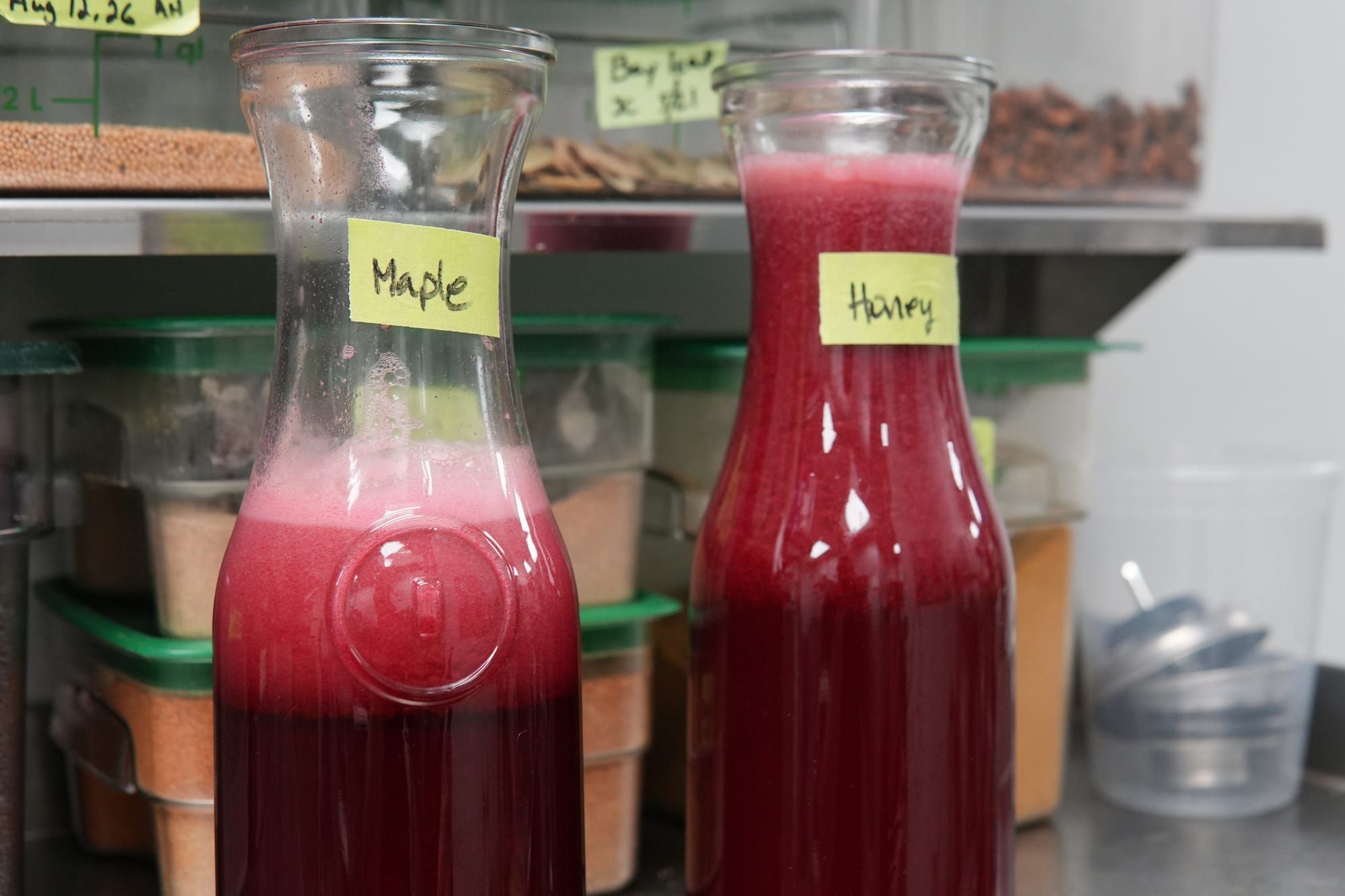
Chef Elizabeth's Prickly Pear Agua Fresca
Tools: blender, pestle, small-hole strainer, chinois (fine-mesh strainer), four-ounce ladle, tongs, and a basket or bowl.
Ingredients
- Prickly pear tunas, whole, peel and all
- Water, just enough to barely cover the tunas in the blender
- Juice of 1 Persian lime
- 1/4 cup maple syrup (or honey)
- Water, about double the puree
Steps
- Twist the tunas off the plant with tongs, into a basket or bowl.
- Give the tunas a light rinse. No need to peel them or remove the spines.
- Add them to the blender without overstuffing. Add just enough water to barely cover.
- Start blending on low, working the fruit down with a pestle, then go to high.
- Double strain: first through the small-hole strainer, then through the chinois, to catch the spines.
- Measure 500 grams of the puree and add the lime juice first. Acid before sugar.
- Add 1/4 cup maple syrup. Adjust to the fruit, since every batch's sweetness differs.
- Add water, about double the puree, and blend.
Tips
- Making a lot? Sweeten with maple syrup only and add the lime juice when you serve. It'll last longer.
- A five-gallon bucket of tunas yields over two gallons of puree.
- Maple syrup for summer. Honey once the temperature drops.
The Transcript
Chef Elizabeth Johnson: I mean, just look at this color. So people go through all the trouble of burning off the spines and then trying to peel them and doing all this stuff. I mean, you can do that, but it's not necessary.
The prickly pear, pads, fruit, and all, have long been an invaluable and iconic food source in Texas. When ripe and ready to harvest, the deep purple fruits are so enchanting and, in Texas, abundant. But a challenge that I often run into with edible wild plants such as this is how do you get it from the plant to the plate? And the more I research native plant foods, like the prickly pear, the more benefit I seem to find in making that exact process, taking it from plant to plate, frictionless.
A food source for humans and wildlife alike, where areas like the South Texas plains that stretch roughly between San Antonio and Corpus Christi, rich with prickly pear stands, was reportedly a magnet for Indigenous peoples during the harvest season. And for good reason. The tunas, while mostly water, carry significant fiber and a good dose of vitamin C and magnesium, and as well, the same antioxidant pigments that turns beets red.
Prickly pear are, of course, abundant in Texas and, for some ranchers, a little noxious. A plant you can literally toss out onto open soil, and odds are it will root and sprout new growth. Now, the most significant barrier to consuming prickly pear, pads and all, no surprise, are the spines. Those obvious and most protruding on the pads themselves, but of course, there's the more subtle and every bit as prickly, the glochids, which are on the tunas, the fruits.
And these are a serious risk. The spines from the pads or tunas can cause severe irritation of the skin, for one, but swallowing them is obviously much worse. In the 1680s, Henry Joutel, a member of La Salle's ill-fated French colony on the Texas coast, wrote that one of his men died after eating the fruit greedily without wiping it. The tiny quills inflamed his throat until he suffocated.
And this is why I sought help from an expert, a friend of mine, Chef Elizabeth Johnson, who owns and operates Pharm Table in Southtown San Antonio, Texas. Truly my favorite restaurant. Her commitment to farm-to-table cooking and finding unique and compelling ways to bring locally foraged native food plants into her dishes is unmatched. A meal at Pharm Table leaves you not only feeling nourished, but truly inspired for what your food can and should be.
So with Elizabeth's help, here's one of the easiest ways to process and enjoy the bountiful harvest of one of Texas's iconic plants. But be sure to stick around to the end to see what a simple harvest of prickly pear tunas looks like.
Chef Elizabeth Johnson: If you think about sustainability and you think about regeneration just for a minute, think about a plant that never goes away, that gets bigger and better with each year, and allows you to not only harvest it for the actual pads, right? They help with the glycemic load. They are loaded with electrolytes, vitamins, water. Nopal, meaning the prickly pear paddles, are just an amazing source of nutrients, as well as a heritage food.
Think about the fact that this holy plant can produce that all year long, then it can produce these fruits for this very substantial season, and then we can also get the cochineal for other practices, whether that's coloring, whether that's food or non-food-related. I mean, think about all the arts and the crafts. You think about the red coats that the British had. Those came from cochineal. So cochineal at the time of the conquest was not only a tribute within Mesoamerica, but it was something that the Europeans took back to Europe, and it became a really important part of the economy. I just can't think of another plant, except for maybe the agave, that has all these different practices and all these different applications.
I'm very lazy, right? So I don't take off the spines. You can see the little spines that are here. I don't do any of that. I just put the entire fruit, peel and all, here. I don't peel it because in so many of our fruits and vegetables, most of the phytonutrients, meaning the plant nutrients, are actually in the skins. And what are we used to doing? We're used to removing the skins. So I try not to remove the skins when possible. What I do here is I rinse them off, and then I try not to stuff them inside my blender. I don't want to overstuff them. So we're going to give this a light rinse.
The trick here is to use a pestle so that you don't have to add so much water. We want to add just enough water so that we're barely covering, because at the end of the day, we don't want to water down the prickly pear itself. We're going to stick this down, and this is going to help me work it. So I'm going to start at a very low, and then I'm working this. I'm going to bring it up. Now let's go on high.
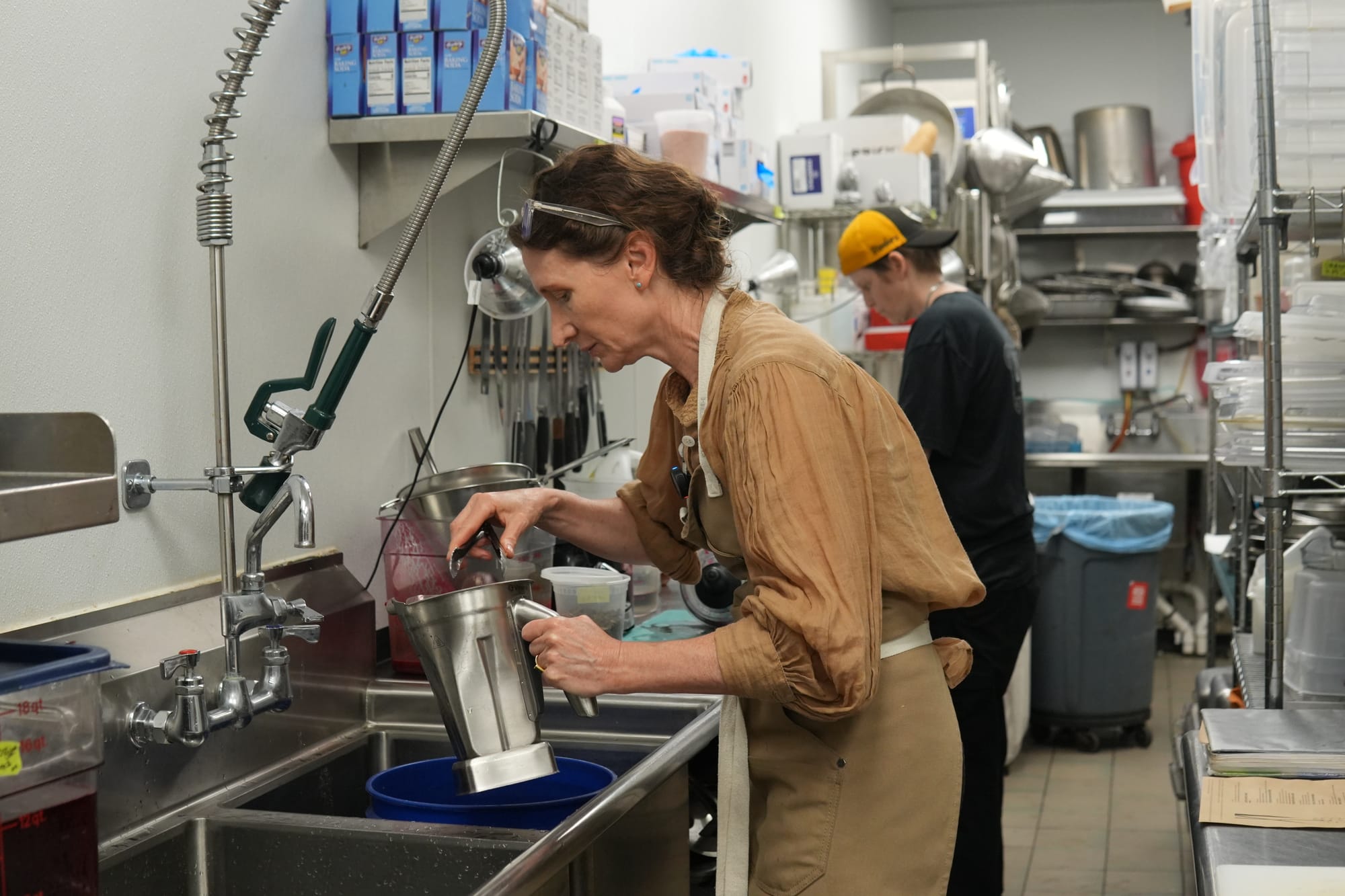
And now what I like to do, you can go to your local restaurant supply store. This is a small hole strainer. You can see how small the holes are. And then this is called a chinois. The difference is that this is fine mesh, and this has bigger holes. I like to be very careful that I'm not getting any of the spines, so I try to double strain it. I like to use a four-ounce ladle. And then again, it depends on how much water you're adding. The more water you add, the more sweetener you have to add, or the more you have to cook it down to remove the water. But if you just use this, it goes pretty quickly.
And then we've even tried to figure out, well, what can we do with the stuff that's left inside the strainer? Can we ferment it? Can we use this as an infusion for a vinegar or for a syrup? There's so many different ways that you can fully utilize products before they go to the compost bin.
So that gave us a little less than a quart. This whole five-gallon bucket will probably end up yielding us definitely over two gallons. And so again, this is all we're going to do. We're just going to keep going until we've processed whatever we need for service.
And I mean, just look at this color. The other thing to note is that when you add acid to this, so let's say you add lime juice, lemon juice, you should always add your acid before you add your sugar, because you cannot perceive sweetness without acid.
So what I'm going to do is take some of that puree, and the first thing I'm going to do is add some lime juice to it, and that's going to let me know how much sugar I'm going to need. Because look, every time we're dealing with a fruit, the reality is that we're dealing with a volatile plant. We have no idea what the Brix are in this particular fruit. So I would say that you can have estimates of how much sugar you may want to add, but it should never be hard and fast, because you have no idea what the Brix are inside that particular product.
So I'm going to put 500 grams of the actual prickly pear juice, which by the way has some water in it. I'm going to put the juice of one lime. These are Persian limes. They are sweeter than the key limes that are in the grocery store. The key limes have a little bit more acidity in them. So these are going to be bigger, and they're going to be sweeter. So we're going to add a little bit of maple syrup. We could add honey as well, but the maple syrup is actually going to emulsify better. That's about a fourth of a cup, so I'm going to do a fourth of a cup of maple syrup. For 500 grams of prickly pear puree, I'm doing a fourth of a cup of maple syrup.
And then what I'm going to do now is add enough water to where I get to just underneath the max line here. So I'm basically doubling the amount of water to prickly pear puree. I'm going to go ahead and start at the bottom, start blending.
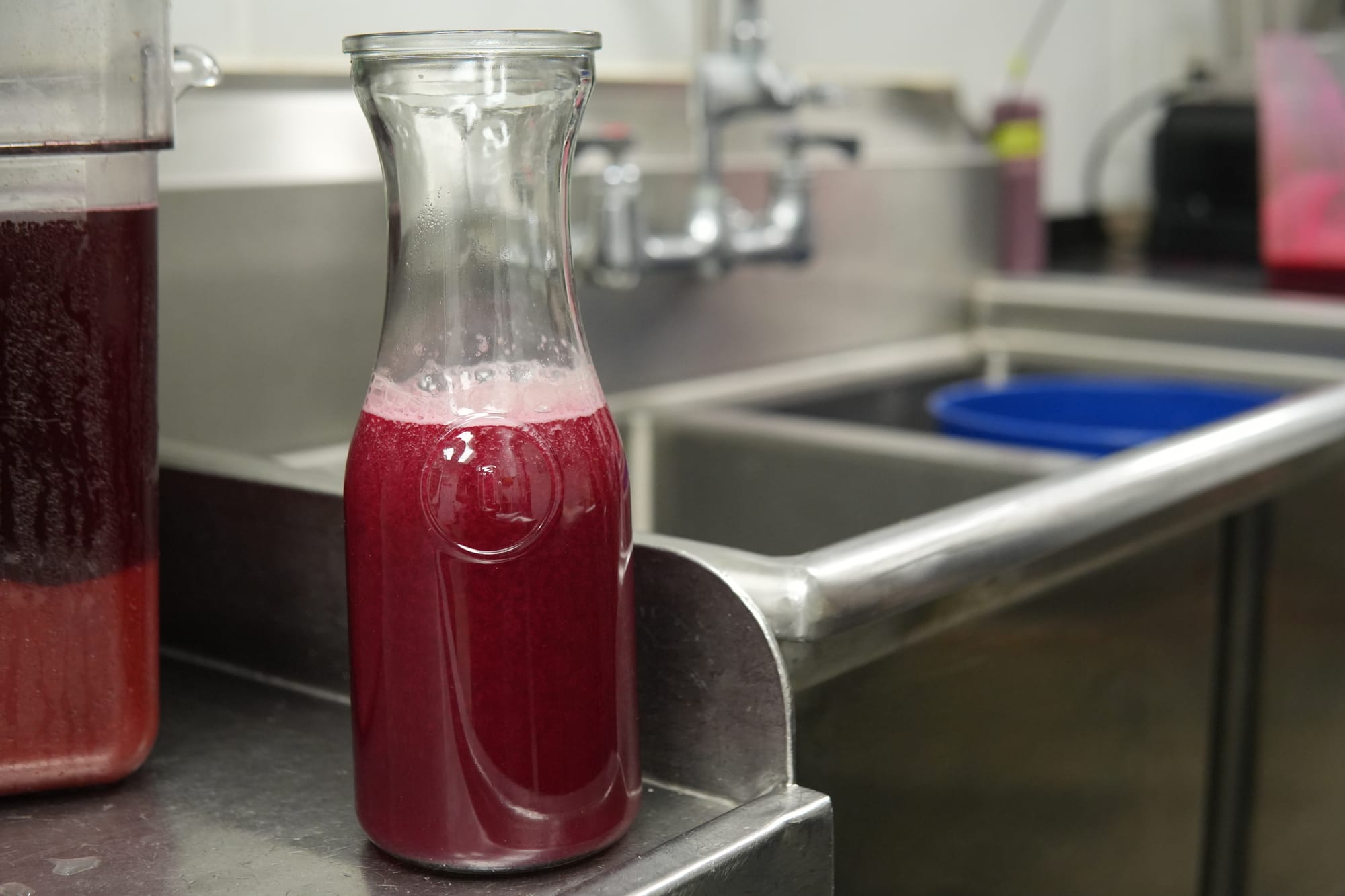
So, moment of truth, let's see what we think about the sweetness. I think it's lovely. It just tastes so healthy. It tastes so refreshing. And you could be drinking this all day long. This is better than Gatorade. Already with the natural electrolytes.
It's not what I expected. It tastes incredible.
Chef Elizabeth Johnson: If you're going to be harvesting these, I recommend a basket or a bowl, and then a pair of tongs. And then you just literally twist them off the plant. The other thing is that if you're going to make this at home and you're going to have a lot of it, don't add the lime juice to it. Just leave it with the maple syrup, and then add lime juice when you serve. That'll make it last longer, because if you add the lime juice to it, it'll have a shorter shelf life. So if you have a lot of it, it would be better for you to just sweeten it with the maple, and then add lime to serve.
Now we're going to taste the difference between honey and maple syrup. So what do we think? Honey is more warming. So again, in the Ayurvedic world, maple syrup would be better for the summertime. Honey would be better for fall, once the temperature has dropped, winter, spring. In the Ayurvedic world, we use sweeteners for different things, for different times of the year.
So in Mexico, they'll take these tunas, they'll take this juice, they'll cook it down with sugar, and they'll make a paste. Like you've had the membrillo before, the Spanish membrillo, which is eaten a lot with cheese. If you go to Brazil, they call it Romeo and Juliet, and it's guava. They cook down guava. They also cook down banana. They cook down other tropical fruits. In Mexico, they call it ate con queso. So you can make ate with this prickly pear.
And if you go to Northern Mexico, places like Zacatecas, some of those northern states, you'll go, oh my God, because the Mennonites, they have queso menonita. They have the ate de tuna, because these are called tunas in Mexico. Atún is the fish tuna, and then tunas are the prickly pear. If you go to the Canary Islands, all the islands are covered with these, and these have become a really important part of their food identity, their food program.
You can make gin out of the tunas. You can make all sorts of things. Obviously, jelly is a no-brainer, right? So anything sweet. Sorbet is on the table, salad dressings. The sky's the limit. You could make a smoothie out of this. Who needs dragon fruit? Who needs acai? Seriously, how much more sustainable would it be for everybody to make their smoothies out of prickly pear?
Well, at the time of this recording, early fall, we're at the tail end of prickly pear's fruiting season. You might be able to sneak one last harvest in if you're lucky to find some fruits. I know I still see some stands with plump magenta emblems atop the pads like we have here. But whether you harvest now or the next year, the process doesn't need to be that complicated.
Cheap kitchen tongs, a Tupperware bucket or bowl you don't mind mixing temporarily with some spines, and you're good to go. Of course, I'd always advise for more gear than maybe what you'll see my wife and I did with our boys the other day. But leather gloves, boots, and pants as you mix it up in the cactus patches, always a good idea. If your spines on the pads or the glochids on the tunas is high, and their removal will require tweezers. And if you'd like to bring the seasonal wild harvest home, planting prickly pear in your landscape is really a breeze.
If you're picking up a plant from a native plant nursery, like my friends at Pollinatives in the San Antonio area, or just slicing a pad off from a neighbor's patch, with their permission of course, a cactus like Texas prickly pear might like best being put into the ground, or on top of the ground for that matter, in spring after the threat of a last freeze has passed, versus the fall. But then again, if you're impatient like me, depending on how severe your winter might be, odds are that new prickly pear will be just fine. Truly, the one thing I've ever seen take down patches of prickly pear down in Texas was the Winter Storm Uri of 2021.
But of course, those same patches did often bounce back.
Share
Written by
Cory Ames
Cory Ames is a writer, naturalist, and filmmaker in San Antonio. Through films, interviews, and field notes, he’s documenting Texas one plant, place, and person at a time, helping Texans find out where they live.
All posts by Cory Ames